Showing posts with label beer. Show all posts
Showing posts with label beer. Show all posts
Friday, September 9, 2011
Argon beer, an alternative to the usual CO2 carbonation
Most beer is carbonated with 100% CO2. Some beers, notably Guinness and some other porter/stouts, contain a mixture of nitrogen and CO2 in a ratio commonly 75/25 N2/CO2. The nitrogen is less soluble in water, and allows the beer to be served at a higher pressure without dissolving too much gas into the beer itself. The higher serving pressure churns up the beer as it exits the spout, and creates a creamy head that is the signature of a good Guinness pour. Some pubs use 75/25 gas to push normally carbonated beers out of the tap, but the beers themselves contain only CO2.
In this video I wondered what would happen if I used argon instead of nitrogen. I started by using %100 argon since the solubility of Ar is between that of N2 and CO2. As it turns out, the Ar is not soluble enough to produce a decent head on the beer. Additionally, the complete lack of CO2 makes the beer taste sweet (like it's flat) since the CO2 is necessary to form carbonic acid in water, and this is an important flavor component of beer.
Xenon has anesthetic properties at atmospheric pressure, while the other noble gasses can become anesthetic at higher pressures. Does anyone want to explore xenon beer, or have any experience with xenon used as an anesthetic?


Monday, December 6, 2010
Installing beer taps in my house
Since moving into my new house, I have been planning to install beer taps into a dining room wall. Tonight, I have completed my goal and drank the first beer from the new taps.
 The faucet on the right is frosty since I just poured a victory beer. I haven't found/made any handles yet.
 In this photo at the bottom left, you can see the white keg refrigerator under the counter in the kitchen, which is adjacent to the dining room. I chose this location for the fridge, since the beer lines could be kept short, and would lessen the need for beer line cooling.
 Here's the view from the kitchen.
 There is a foam-insulated bundle of hoses running from inside the fridge into the wall between the kitchen and dining room.
 The fridge holds two of my beer fire extinguishers ("thirst extinguisher"), a CO2 tank, regulator, all kinds of different tubing and a cooling fan that blows cold air from the refrigerator up to the space behind the beer taps.
 This fan is coupled to a 5/16" ID hose that travels up the foam insulated tube to the chamber behind the beer taps. The air returns to the fridge through the space between the beer lines and foam tube.
 I later sealed the back of this styrofoam chamber with another panel of styrofoam so that any air blown into the chamber would build up a small amount of pressure and be expelled through the foam tube. I wrapped the foam tube in duct tape to provide an additional moisture barrier.
Notes:
I used 1/4" ID hose between the kegs and the taps. This was not a good choice. For short runs, 3/16" is better since you can keep the keg pressure at 10-12 psi at around 40*F, and open the tap wide open without the beer exiting too quickly. The 3/16" hose provides substantially more backpressure than 1/4" hose. I will experiment with in-line restrictors since I am NOT taking all of this apart to change the hose size. There is a lot of vague/wrong/incomplete information on the internet about dispensing beer, so that doesn't help either.
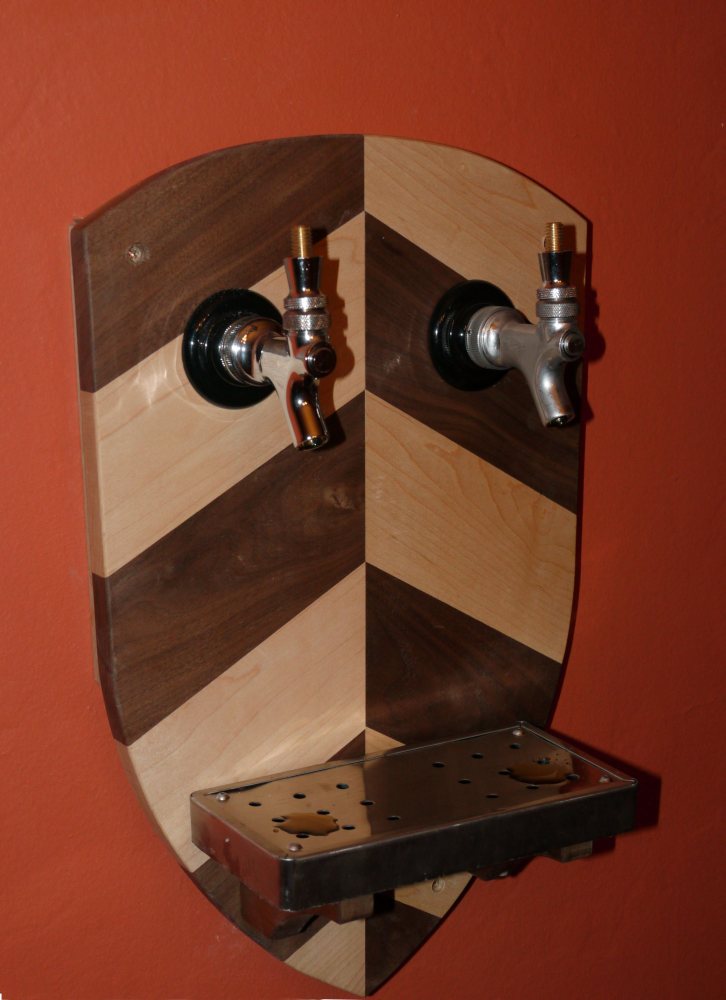 The faucet on the right is frosty since I just poured a victory beer. I haven't found/made any handles yet.
 In this photo at the bottom left, you can see the white keg refrigerator under the counter in the kitchen, which is adjacent to the dining room. I chose this location for the fridge, since the beer lines could be kept short, and would lessen the need for beer line cooling.
 Here's the view from the kitchen.
 There is a foam-insulated bundle of hoses running from inside the fridge into the wall between the kitchen and dining room.
 The fridge holds two of my beer fire extinguishers ("thirst extinguisher"), a CO2 tank, regulator, all kinds of different tubing and a cooling fan that blows cold air from the refrigerator up to the space behind the beer taps.
 This fan is coupled to a 5/16" ID hose that travels up the foam insulated tube to the chamber behind the beer taps. The air returns to the fridge through the space between the beer lines and foam tube.
 I later sealed the back of this styrofoam chamber with another panel of styrofoam so that any air blown into the chamber would build up a small amount of pressure and be expelled through the foam tube. I wrapped the foam tube in duct tape to provide an additional moisture barrier.
Notes:
I used 1/4" ID hose between the kegs and the taps. This was not a good choice. For short runs, 3/16" is better since you can keep the keg pressure at 10-12 psi at around 40*F, and open the tap wide open without the beer exiting too quickly. The 3/16" hose provides substantially more backpressure than 1/4" hose. I will experiment with in-line restrictors since I am NOT taking all of this apart to change the hose size. There is a lot of vague/wrong/incomplete information on the internet about dispensing beer, so that doesn't help either.

Thursday, March 26, 2009
Thirst extinguisher
This is an old, but good, project that I built a few years ago. I retrofitted a commercial fire extinguisher to hold and dispense beer. I brew my own beer at home, so it is fitting to have a homemade "keg" to hold homemade beer!
The extinguisher tank is stainless steel, and fairly easy to clean. The top unscrews, and leaves a 3" dia hole. The extinguisher was originally setup to dispense fluid (ie it has a downtube that connects the outlet to the bottom area of the tank, and a port on the top for adding pressurized gas). This is exactly what we want to dispense beer. The main modifications that I made were:
Replacing the original (nasty) downtube with a new clean one
Replacing all of the rubber seals with new ones
Lots of cleaning
Added a low pressure gauge and compressed air quick-connect system (not shown in the photos)
More cleaning

I got my CO2 cylinder and regulator at a local welding supply store. It was expensive, and I am not sure if it was worth it.
In order to carbonate the freshly brewed beer, I keep the extinguisher in the refrigerator with the CO2 tank set for about 12 psi. I give the beer a vigorous shake once or twice a day, and after a few days or a week, it is ready.

The extinguisher is always a hit at parties, and has become a tradition.

The extinguisher tank is stainless steel, and fairly easy to clean. The top unscrews, and leaves a 3" dia hole. The extinguisher was originally setup to dispense fluid (ie it has a downtube that connects the outlet to the bottom area of the tank, and a port on the top for adding pressurized gas). This is exactly what we want to dispense beer. The main modifications that I made were:
Replacing the original (nasty) downtube with a new clean one
Replacing all of the rubber seals with new ones
Lots of cleaning
Added a low pressure gauge and compressed air quick-connect system (not shown in the photos)
More cleaning

I got my CO2 cylinder and regulator at a local welding supply store. It was expensive, and I am not sure if it was worth it.
In order to carbonate the freshly brewed beer, I keep the extinguisher in the refrigerator with the CO2 tank set for about 12 psi. I give the beer a vigorous shake once or twice a day, and after a few days or a week, it is ready.

The extinguisher is always a hit at parties, and has become a tradition.

Subscribe to:
Posts (Atom)